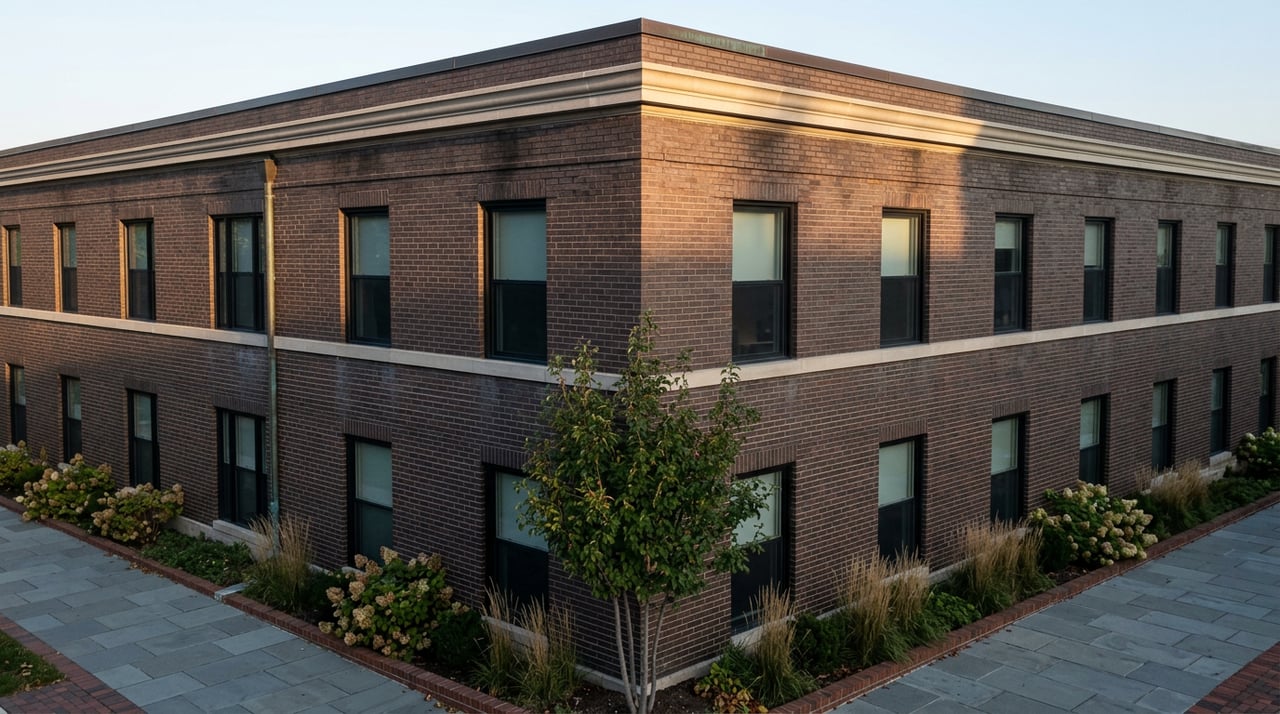
Bryn Mawr Historic District: Edgewater Landmark Plans Explained
September 17, 2026
September 17, 2026
Stand at Bryn Mawr and Broadway on a Saturday afternoon and you're at the meeting point of two different planning efforts. Along Bryn Mawr, the Commission on Chicago Landmarks spent 2026 advancing a proposed historic district. Along Broadway, the city's 2025 land-use framework recommends denser zoning. Same neighborhood, different years, opposite directions, and the seam between them runs right through that corner.
Most people who've lived in Edgewater long enough to remember the Red Line construction years know pieces of this story. Fewer have connected them, because they showed up in the news as two separate fights: a historic district and a zoning framework. They're not separate. They're the same 48th Ward, the same alderwoman, and in one specific case, the same parcel.
The Bryn Mawr Historic District covers the 900 through 1100 blocks of West Bryn Mawr Avenue, from Sheridan Road to Broadway, and it's been a long process. The Commission on Chicago Landmarks gave it a preliminary recommendation in April, held a public hearing in June, and voted unanimously to give it a final landmark recommendation in July, clearing the way for Mayor Brandon Johnson to introduce the designation to City Council on July 15. Fifteen buildings, constructed between 1897 and 1928, count as contributing structures. That includes the eight-story Belle Shore Apartments at 5550 N. Kenmore Ave., the Tudor-styled Manor House, and the Edgewater Beach Apartments at 5555 N. Sheridan Road, the one longtime residents know by its color as much as its name.
The same hearing that recommended landmark status also denied a demolition permit for 1114 W. Bryn Mawr Ave., a two-story brick building from 1909 with Classical Revival details. The developer, Harlem Irving Companies, has reportedly put $6 million into the site since buying it in 2020 and wants to build a 95-unit apartment building there. The city sided with the building. Preservation Chicago has since floated a compromise: keep the historic facade and let Harlem Irving build behind and above it, a solution the group notes has worked elsewhere in Chicago.
Edgewater Historical Society President John Holden has watched this stretch cycle through good years and bad. The corridor had a real comeback three decades ago, he's said, before COVID and years of Red Line reconstruction knocked it back down. Ald. Leni Manaa-Hoppenworth, whose ward office sits inside the district, has framed the landmarking as something that works with development rather than against it, not a freeze on investment but a way to direct it.
That's the piece most coverage stops at: a preservation win, a demolition denied, a corridor getting its legal protections in order after a rough decade. The more interesting question is what's happening one block away, on the street this district dead-ends into.
In February 2025, the Chicago Plan Commission adopted the Broadway Land Use Framework, a plan covering Broadway from Devon Avenue down to Montrose, running through Edgewater and into Uptown. Save Edgewater says the framework recommends replacing the corridor's patchwork zoning with a single denser designation, mostly B3-5, which opens the door to mid-rise buildings up to roughly 80 feet on stretches that are currently capped much lower. Chicago Sun-Times reports that any building with more than 10 units built under expanded zoning has to set aside 20 percent as affordable housing, per the city's existing ordinance. The commission passed it 12 to 1.
Here's the detail that ties the two stories together. One of the sites the city specifically called out as ready for this kind of redevelopment sits right at Bryn Mawr and Broadway, a lot that's spent the last several years serving as staging ground for CTA construction equipment. The framework and its supporters have pointed to that exact corner as a candidate for affordable, transit-oriented housing once the equipment clears out. It's the same corner the historic district's western boundary touches.
The fight over the framework hasn't been quiet. Ten block clubs in the 48th Ward sent a joint letter opposing the pace and scope of the rezoning, and Norm Cratty, acting president of the North Edgewater Beach Association, told the Plan Commission the process ignored what his neighbors wanted. Wilson Hartz, who lives in the Lakewood-Balmoral section of Edgewater, another area on the National Register of Historic Places, argued that 80-foot buildings don't belong next to the residential blocks behind Broadway. On the other side, residents like Donovan Harvey and Neville Hemming spoke in favor, arguing that density near the Red Line is exactly what a housing-short city needs, and that the difficulty of finding an affordable home in Edgewater made the case for them personally.
Manaa-Hoppenworth voted for the framework and has since said she's pushing back on applying the densest zoning category to the west side of Broadway north of Foster, a position that has prompted differing reactions. Either way, the zoning changes themselves still have to clear City Council before anything gets built differently than it is today.
So the proposed landmark district for Bryn Mawr and the Broadway framework's recommended zoning changes point in different directions. Together, they frame a neighborhood debate over what to preserve and where to allow more growth.
None of this is theoretical anymore on Bryn Mawr itself. The Red Line's Bryn Mawr station reopened in the summer of 2025 after years of closure during the CTA's Red and Purple Modernization project, and the corridor has been filling back in since. Teranga African Restaurant, serving Senegalese dishes like fataya hand pies and fish yassa, opened at 1131 W. Bryn Mawr Ave. Herb, a few blocks over on Broadway, has held a Michelin Bib Gourmand recognition for its Thai menu for several years running. Both were part of this year's North Side Restaurant Week lineup, alongside Chengdu Impression, Regalia, and a dozen other Edgewater kitchens running prix fixe menus in a joint promotion with Rogers Park, Lincoln Square, and Northcenter.
That's the texture the policy fights don't capture: a corridor that spent years boarded up around construction equipment is now busy enough to support a restaurant week partnership with four other neighborhoods.
The next few years on this stretch of Edgewater are going to look like two different planning philosophies operating a block apart. Broadway, a block or two in either direction, could become a place where the zoning code permits buildings taller than almost anything currently standing there, contingent on City Council passing the ordinance changes the framework recommends.
If you live along Bryn Mawr, the character of your block is about as settled as Chicago zoning gets. If you live along Broadway, especially north of Foster, the shape of your block is still being negotiated, and the alderwoman representing you has since called for changes to one part of the framework. Either way, the corner where these two policies meet, sitting on land the CTA no longer needs for construction staging, is probably the single spot in Edgewater worth watching over the next couple of years to see which version of the neighborhood's future actually gets built first.
If you're thinking about what any of this means for a specific property on or near this corridor, that's exactly the kind of block-by-block detail worth a real conversation rather than a guess. Patrick O'Brien has been tracking these Edgewater changes as they've unfolded. Let's connect, start with a free home valuation.
This article is general information, not legal, tax or financial advice. Consult a qualified professional about your situation.
Stay up to date on the latest real estate trends.
Whether you're preparing to sell, beginning a home search or simply trying to understand your options, let's have a conversation about your goals and the market.
Patrick O'Brien
Office Address
2350 NORTH LINCOLN AVE 3RD FLR
CHICAGO IL 60614